
Genesee Township City Directory Holdings
Flint Public Library is the practical starting place for a historical directory question tied to Genesee Township. Its Local History & Genealogy Room holds R. L. Polk volumes from the 1890s to the present for Flint and surrounding communities. The collection is a strong lead, not a guarantee that each year includes every township road. Check the title page, publisher, geographic wording, and the relevant street or surname section before treating an entry as a township result.
| Collection | Years | Where Held | Access |
|---|---|---|---|
| R. L. Polk Flint and surrounding-community directories | 1890s to present; township coverage varies by year | Flint Public Library Local History & Genealogy Room | Consult the volume and its geographic coverage in person |
| Bresser criss-cross directories | Late-1960s guide reference; exact local run needs verification | Library directory holdings | Address-first sections, where held for the selected year |
| Digitized Flint directory leads | 1918, 1920, 1922, and 1965 leads identified | Google Books | Online bibliographic and scanned-volume lead; inspect coverage |
| Flint Genealogical Society directory and homes material | Late 1800s through the 1970s | Flint Genealogical Society publication resources | Ask about the specific publication or research route |
The Library of Michigan explains why these books matter: they can supply a household head, family clue, exact address, occupation, ownership indicator, business reference, or phone clue between census years. Those fields differ by publisher and date. A Flint address is also not automatic proof of a location inside the charter township, since the volumes can cover a wider local area.
Genesee Township City Directory Desk
The Flint Public Library Local History & Genealogy Room is on the lower level at 1026 E. Kearsley Street in Flint. The phone number is 810-232-7111. Temporary local-history hours cited by the library are Tuesday through Thursday, 11 to 5; Friday, 9 to 4; and Saturday, 9 to 6. Hours can change, so verify before traveling. The room supports a hands-on search with microfilm reader/scanners, scanners, a color printer, Ancestry Library computers, and save-to-USB or email options.
The collection began with a 1905 DAR gift and now emphasizes Flint, Genesee County, Michigan, and nineteenth-century material. That history makes the room more than a shelf of phone books. A researcher can use a 30-minute Book an Expert appointment, while fragile and Special Collections material is handled with staff mediation. Bring the exact spelling, alternate spellings, a year range, and the address as written in the family material.
See the library's Local History & Genealogy Room before visiting.
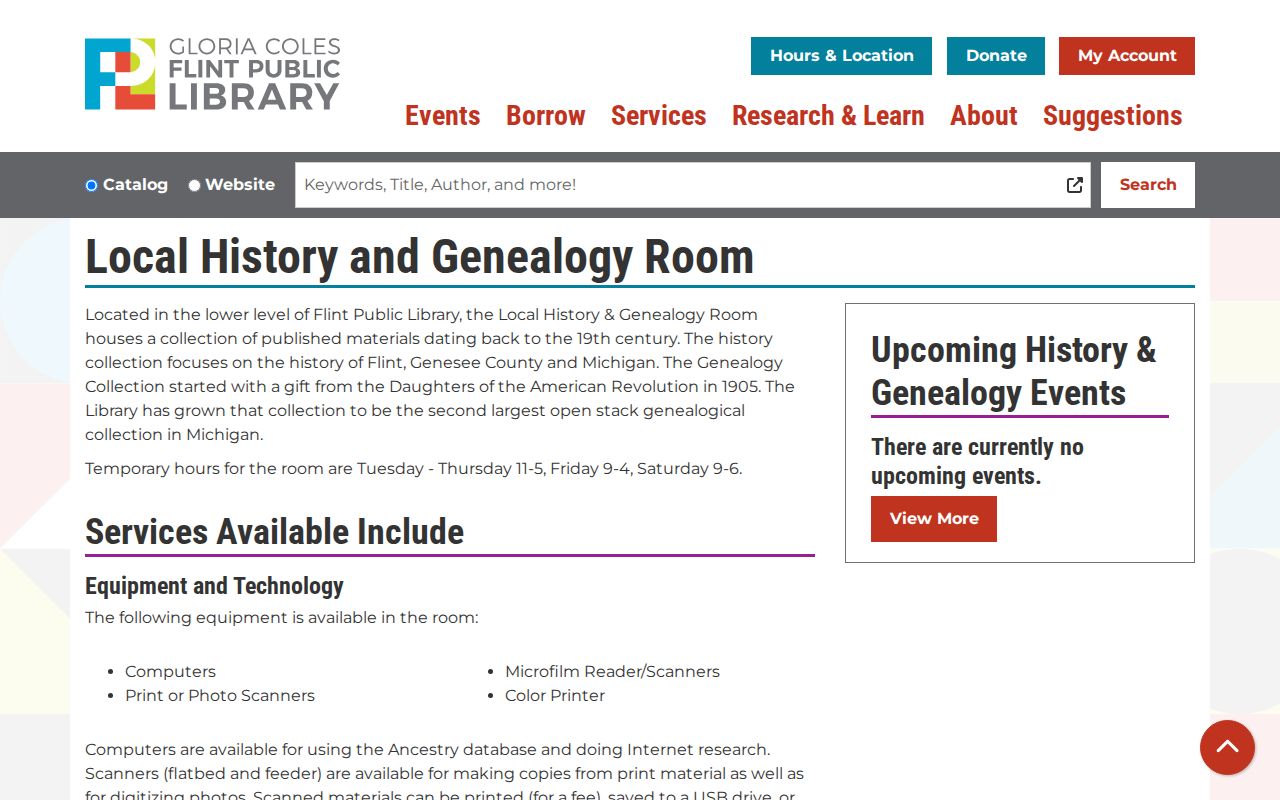
The room is the best place to compare a directory volume with its companion microfilm, local map, obituary, or biography-file lead without separating those dated sources.
Reading Genesee Township City Directory Entries
A directory entry should be transcribed as the book presents it, including initials, street abbreviation, and any mark described in that volume's key. The Library of Michigan notes that Polk surname pages commonly give household and occupation information, while a street section is arranged by street and house number. Some editions include owner or renter indicators, business listings, or a numeric phone list. None of those fields should be assumed when a selected book does not print them.
| Name or household head | The name indexed by the publisher, sometimes with a family or household clue. |
|---|---|
| Address | The printed house number and street, a date-specific location rather than a present-day claim. |
| Occupation or business clue | A historical role or listing that can help distinguish same-name entries. |
| Owner or renter indicator | A notation used in some editions; read the volume's own key before interpreting it. |
| Phone or first-listed clue | Information available in certain directory formats, often associated with the household head. |
- Criss-cross directory
- An address-first directory arranged by street and house order, useful when the starting point is a property rather than a surname.
- Householder index
- A name-oriented arrangement that points from an indexed household name to its printed address or listing.
- Abbreviation key
- The publisher's explanation of shortened terms and marks. Photograph or copy it before relying on a notation.
Genesee Township City Directories by Street
Bresser volumes are particularly useful when research begins with a street. Their criss-cross arrangement places streets alphabetically and houses in order, with reported fields such as household head, phone, ownership indicator, and year first listed. The Library of Michigan also identifies Robinson's, Norton's, Johnson Publishing, W. C. Bailey, and Luedder among directory publishers. Publisher names help date the format, but they do not establish that a particular run covers Genesee Township.
For a historic address, start with the street section, then check the surname section for the same printed name. Keep the page number and publication year with both notes. If the street is absent, test the spelling, road type, direction, older post-office label, and nearby city listing before deciding the volume lacks the address. Modern parcel and title work belongs on the Genesee Township by-street directory resource, not in an old-directory result.
Digitized Genesee Township Directory Leads
Online copies are helpful for a quick title, year, and page check. Google Books lists a Flint, Michigan City Directory lead that includes a 1965 volume, along with older 1918, 1920, and 1922 leads. A 1905 Polk Flint directory page-image lead is also identified through Hathi and the University of Pennsylvania Online Books. Use the library collection and the Library of Michigan guide to understand a volume before drawing a geographic conclusion from one scanned page.
Open the Google Books Flint city-directory record to confirm the particular digitized lead.
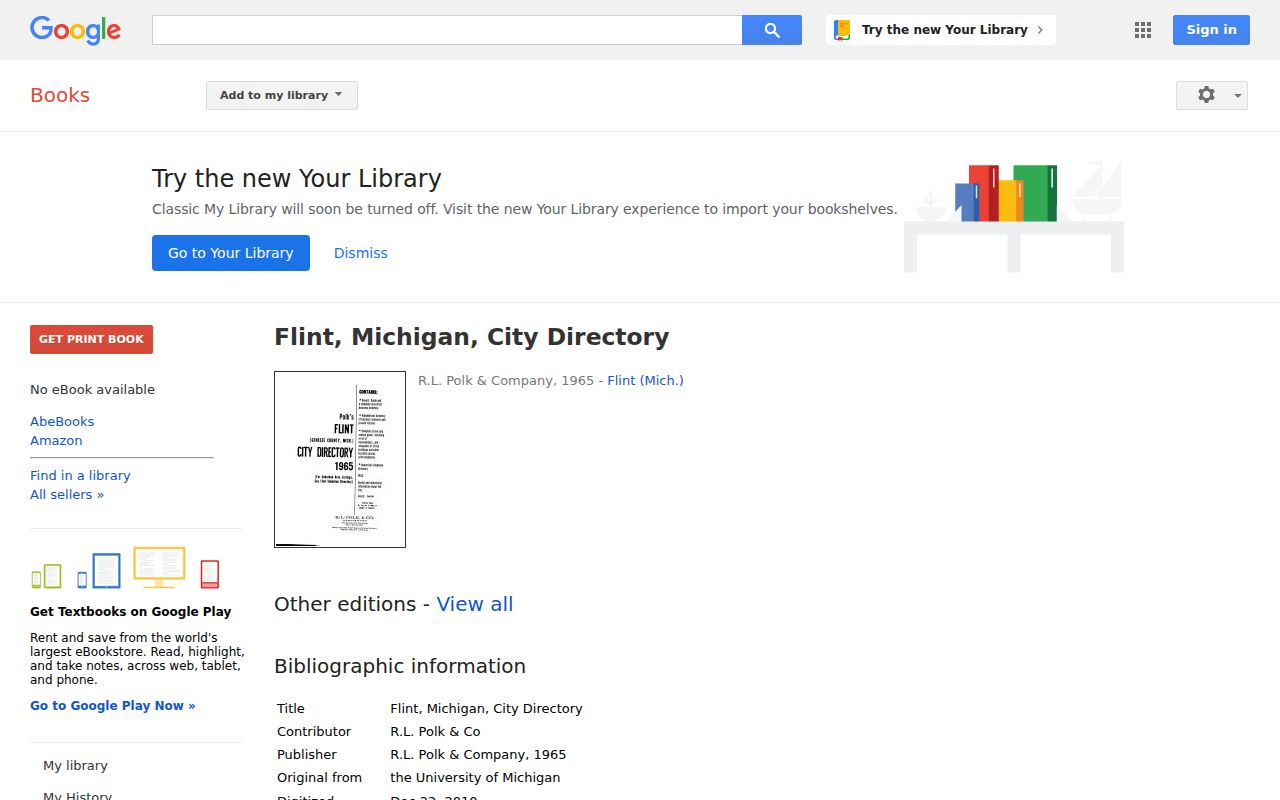
A bibliographic page can identify a volume and year, but the actual pages must still be checked for readable names, streets, and Genesee Township coverage.
The library's house-history guide places directories beside plats, maps, deeds, tax records, census material, and the Biography File.
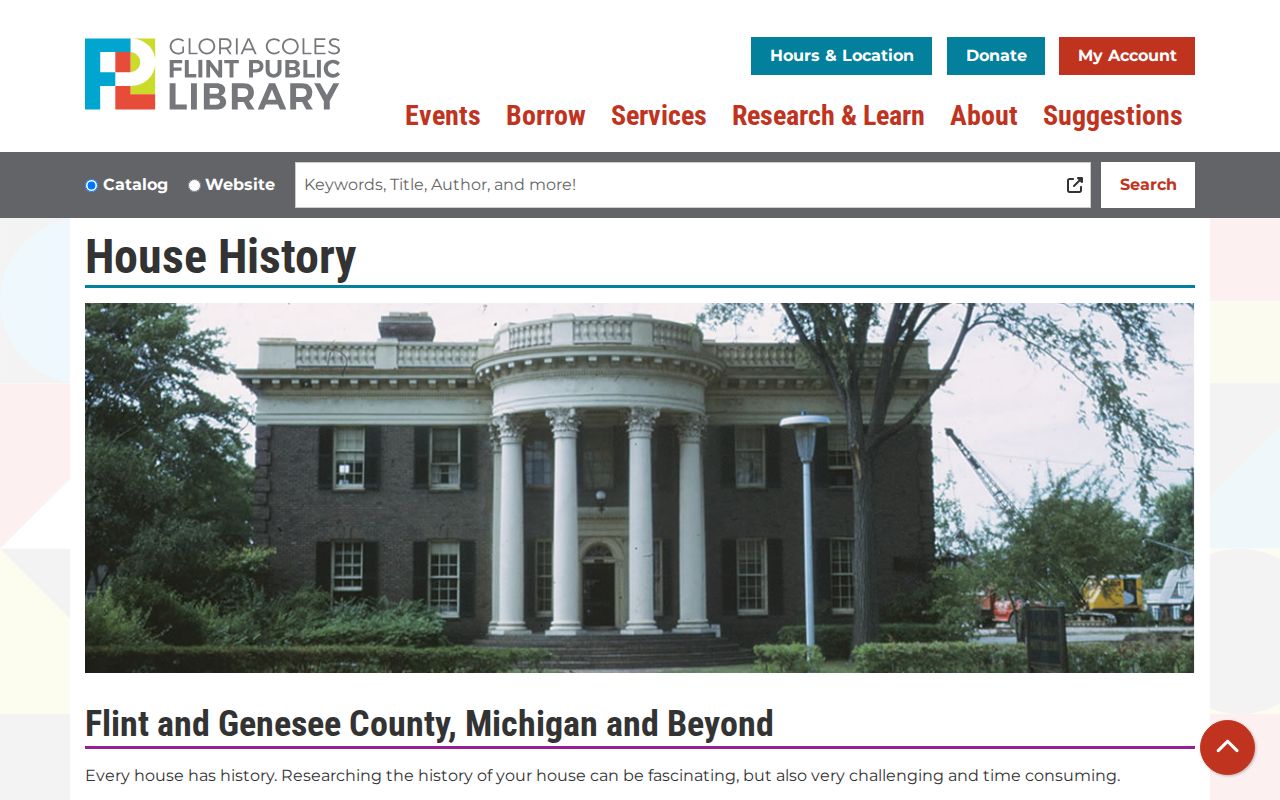
That sequence helps separate an old household listing from a property owner, a building date, or a later family event.
Tracing Genesee Township City Directory Years
Use a dated trail, not a single entry. FPL identifies census microfilm as a companion source and notes that addresses can be useful from 1880 forward, although enumerator coverage and address transcription vary. The goal is to build a small timeline with the name as printed, address, year, publisher, page, and a note about what the entry actually says. A first appearance can mark a new listing, a move into the covered area, or a change in directory coverage.
- Choose the earliest directory year that matches the surname or address, and record the title, publisher, page, and geographic wording.
- Follow the listing through nearby volumes, keeping changes in spelling, address, phone clue, and household notation separate.
- Use an address-first or criss-cross section for the selected year to test whether the printed street sequence supports the household trail.
- Pair the closest directory year with the relevant census material, preserving the census year and its different coverage rules.
- Use an obituary, newspaper microfilm, or the Genesee County Biography File to seek a dated event or fuller clipping.
Flint Public Library's Biography File indexes Flint Journal, county-history, and local-clipping material. Search with the surname plus a street, occupation, or organization, then request the underlying clipping or microfilm page. The Flint Genealogical Society's Redbook indexes vital-record material from 1867 through 1930 and can supply another date anchor, but an index lead still needs the original record or image for confirmation.
Limits of Genesee Township Directories
A dated directory can place a printed household at a printed address. It cannot establish present residence, capture every person in a building, or prove that an address lies inside the charter township merely because a Flint-area volume lists it. The directory may omit a year, use a different post-office label, or limit its geographic reach. A missing result may reflect the book, not the family.
Do not turn a directory entry into a profile of a living person. Michigan's Address Confidentiality Program protects qualifying participants through a substitute-address system, and protected data is not ordinarily produced through FOIA. Historical, family, and house-history work should retain only the details needed for the dated question and should never be used to contact, follow, or harass anyone.
Genesee Township Archive and City Directories
The 1905 DAR gift behind FPL's genealogy collection is a useful reminder that local history survives in several formats. The collection's directories, microfilm, maps, and clippings can lead outward to the Library of Michigan's directory guide, the Flint Genealogical Society publication resources, the Genesee-Johnson branch, and county archival finding aids. Each custodian organizes material differently, so carry the specific place, year, and source citation rather than a broad name-only request.
| 1905 | FPL's genealogy collection began with a DAR gift. |
|---|---|
| 1890s to present | FPL reports Polk directories for Flint and surrounding communities, with local coverage to verify volume by volume. |
| Late 1800s to 1970s | FGS publication resources describe local directory, homes, and business research leads. |
| 1970 to present | County Register of Deeds digitized public documents provide a later property-record companion, not a directory replacement. |
For early land or family questions, the Archives of Michigan guide lists Genesee County assessment, voter, probate, naturalization, and other offline series. Ask for the township, range, section, record type, and date range. That keeps the directory clue attached to a real archive series instead of treating it as the final answer.
The archive can also resolve a gap that a directory cannot. Its Genesee County guide identifies naturalization indexes from 1838 to 1918, deed and mortgage material through the FamilySearch bridge, assessment rolls from 1844 to 1940 plus selected later years, and probate files in several historical ranges. Those series are often organized by county and record group, not a modern search box. Take the directory citation, the township name, and any section or legal-description clue to the archivist so the request can be narrowed before a volume or microfilm series is pulled.